
I am a SmartGit newbie. And I really mean a newbie. Before I started working for SmartGit, I had never heard of SmartGit. I had never heard of Git. And I had never really worked with software developers.
Okay, that last part is not completely true… At my previous company, I worked with four very nice software devs. But most of our conversations happened over coffee or during lunch breaks. Our most intensive professional exchange was probably during workshops about how every department could work more efficiently. So yes, I knew software developers. But I had absolutely no idea what they actually did all day.
When I started working for SmartGit, my first goal was not only to understand what Git and SmartGit are. My main goal was to use SmartGit - every day, as part of my daily marketing work. I knew that I was not a Techie. And, to be honest, I probably never will be. But today, I understand - at least, I hope I do - SmartGit’s strengths, its purpose and why so many people love working with it.

And do you know what? My personal goal is to spread the word that SmartGit is for everyone. Not only for software developers. Not only for people who want a visual way to work with Git instead of relying on the command line. SmartGit can also be useful for project- , marketing- , event managers, administrators, quality managers and people working in law or education. Because content changes. Plans change. Documents change. Projects change. And every change should be visible. With a clean history, you can see what was changed, when it was changed and who changed it. You can understand how something developed and return to an earlier version if necessary. And we all work in teams - every day - even if we sometimes forget about it.
But enough about me and how I came to SmartGit. Let us start with my first impressions and how I learned to use it.
And to be honest: it was really - and I mean really - hard for me. At the beginning, I was confused. I was stressed. I had a headache almost every day. I was completely lost. So I decided to start at the very beginning: with the history of version control. I read about SCCS, RCS, CVS and SVN. More abbreviations. More unfamiliar words. More things I thought I would never understand.
But one day, something clicked.
So, let us start with the history.
Why Version Control Exists
The story begins with a simple problem: several people are working on the same project. Files are changed, mistakes happen - and sooner or later, someone asks: Who changed this? What exactly changed? And can we restore the previous version?
The first version-control systems, SCCS and RCS, stored earlier versions of individual files. That already made it possible to see what had changed and to return to an older version. Then development became more collaborative. CVS and later SVN allowed teams to work with a shared central repository. Developers could work on their own copies and then send their changes back to one central place. SVN improved this approach by treating related changes as one complete commit.
Then came distributed version control. Instead of depending entirely on one central server, every developer received a complete copy of the repository - including its full history. Developers could work locally, experiment and perform many operations much faster. One of the first well-known distributed systems was BitKeeper, which was used by the Linux kernel team. When its licensing model changed, Linus Torvalds created Git in 2005.
And this was my first big “click” moment: Version control did not suddenly appear as one complicated system. It developed step by step because developers needed better ways to track changes, correct mistakes and work together.
If you want to see more of Syntevo’s own history, have a look at 20 Years Syntevo | syntevo blog.
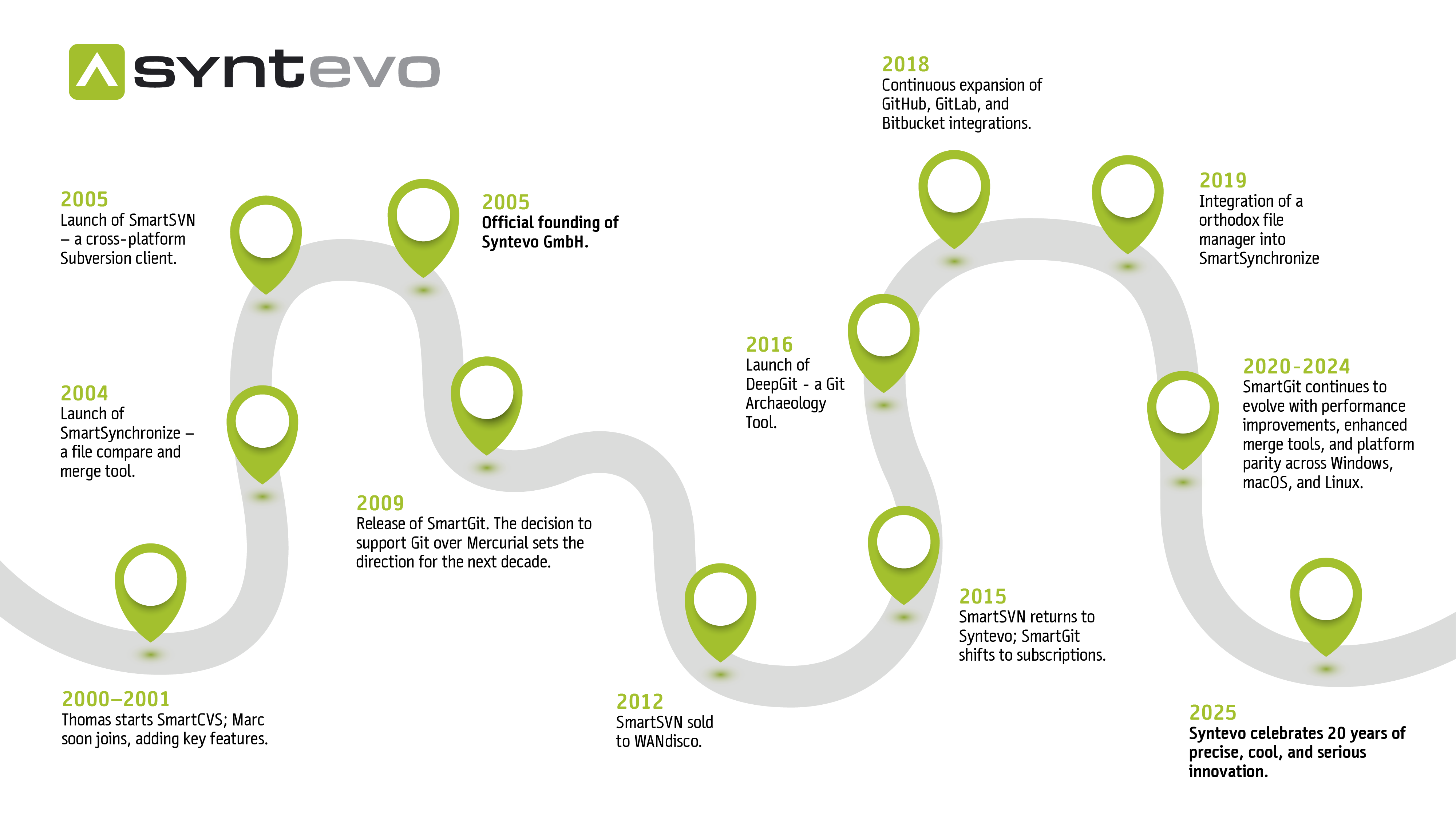
And You Know What? This Is Where SmartGit Enters the Story
Git is powerful, fast and flexible. But it can also be complex - especially when you are a marketing manager looking at branches, commits and repositories for the first time. SmartGit does not replace Git. It makes Git’s processes more visible and easier to understand and manage. For me, that is one of the most interesting things about SmartGit: behind its interface lies decades of experience with version control. And this is something else I only understood later: Syntevo’s experience did not begin with Git. SmartSVN supports Subversion workflows. SmartSynchronize compares files and directories. DeepGit helps investigate the history of a file. And SmartGit supports modern Git workflows. Syntevo did not simply watch version control evolve. Its knowledge and products developed alongside it. The technology has changed considerably - from managing individual files with SCCS to working with distributed Git repositories in global teams.
But the original questions are still surprisingly similar: What changed? Why did it change? And what should I do next? Helping people answer these questions is what SmartGit is built for.
And that was one of my first SmartGit Diary lessons: To understand SmartGit, I first had to understand why version control exists at all.
And with SmartGit, you avoid version control like this - with the files name 😉 Think about it.